Facebook made one quiet change, and increased organic traffic by over 40 million visits a month

Search Expert Saul Westbrook researches how Facebook is utilising AI-summarised pages to win organic search, whether it counts as scaled content abuse, and why having strong Facebook presence may be the next new organic strategy that no-one is talking about.
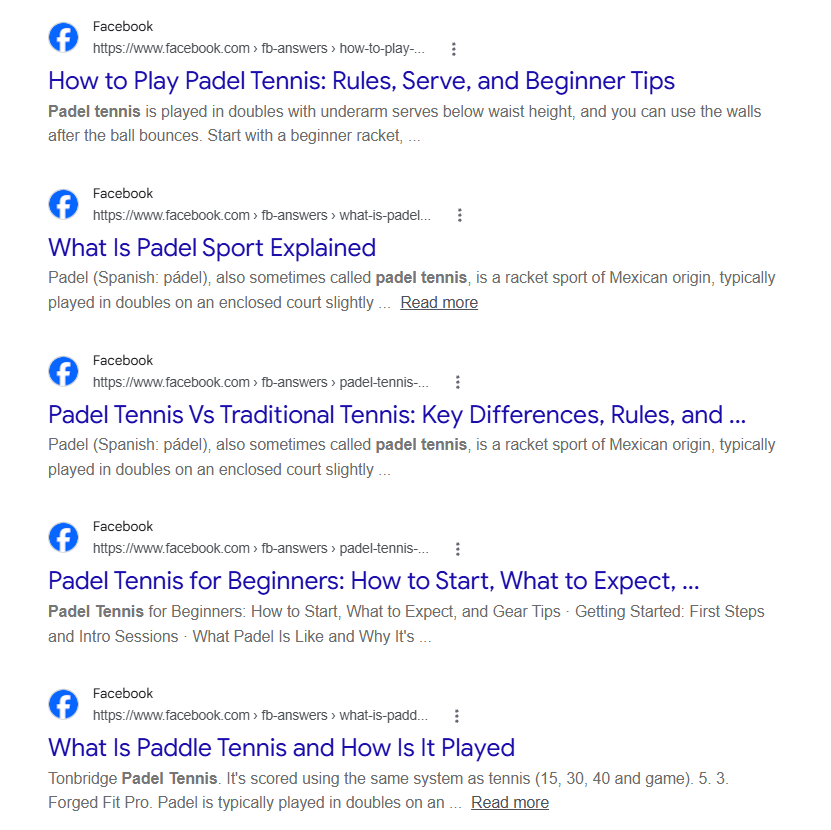
In June 2026, I noticed that Meta had quietly indexed millions of AI-generated Facebook pages under the url facebook.com/fb-answers/, and they were appearing frequently on Google. Each page consists of an AI-generated summary to explain a specific topic, using Facebook posts by individuals and pages as sources for the content.

This came shortly after Meta released AI Mode, a competitor to Google's AI Mode, which is a conversational search engine that uses content from Meta's platforms such as Facebook and Instagram to answer users' queries.
There seems to have been no editorial oversight for this content. Page topics overlap with each other - for example, I was able to find over 180 pages in English on Padel Tennis.
According to Semrush estimates, there are over 39 million of these pages ranking on Google for at least 1 keyword in the US. And worldwide, they are estimated to have driven over 100 million visits since going live in the summer.
Some of these pages are ranking in high positions, and for high-search volume keywords. I've pulled out some example US ranks below:
Amex Travel: 368K search volume, pos 2, 23.9K organic traffic.
Champions League Schedule: 1M SV, pos 9, 22K organic traffic.
LAS Airport Location: 22.2K SV, pos 1, 17.8K organic traffic.
Labcorp: 2.7M SV, pos 6, 16.4K organic traffic.

Although this data is based on Semrush estimates, I think that it is safe to say that by creating these pages, Facebook has brought itself a significant amount of traffic, primarily for informational queries.
I thought this strategy was fascinating and also posed some questions that no-one else was yet asking. Specifically I wondered why Facebook decided to create these pages, and also what response, if any, SEOs could take based on this change
Where did Facebook Answers come from?
As of 3 November, Facebook have not spoken publicly about their implementation of these pages. We have reached out for comment, but have not heard back yet.
The creation of these pages followed the release of Meta's AI Mode in the summer, and the pages are probably static versions of content generated by it, set up to rank in organic search.
These pages link internally to each other through a 'More like this' box at the bottom, and also ask the user whether the result was good or bad. This may have been created to enable Facebook to get feedback on AI Mode's output.

Why might Facebook have created these pages?
From my point of view, I believe that there are a few ways that Facebook could stand to gain from Facebook Answers:
Organic visibility
Most of these pages rank for informational queries, suggesting that there is little immediate commercial value to ranking for them. However, funnelling 100 million extra users on to the site through organic search allows Facebook to get more potential customers into their ecosystem.
Each page has clickable sources which can take searchers to view that post and continue on Facebook. Also, if someone accesses an Answers page whilst logged in, they may stay on Facebook, having access to the search bar and notifications.

Competing with Reddit
Reddit has shown how user-generated content can bring in new users through organic search.
According to Semrush, they receive 1.8 billion monthly visits from Google worldwide. Searchers are often drawn to Reddit because of its authenticity, as all of its content (at least in theory) has been created by real people who want to share their experiences.
It's likely that Facebook has realised that it can make further use of organic search and their UGC to bring in new visitors. Already group and page posts rank frequently on Google, but combined with well-structured AI summaries, Facebook Answers offers informative content, whilst giving users a selection of authentic answers to substantiate it.
More data
Getting more users to the site allows Facebook to understand what kind of questions people want to know the answer to. This data could be used, for example, to improve its own AI Mode, so it can provide more useful answers to its current users.
Facebook Answers: what does the data say?
These pages first appeared on the SERP in May and the table below shows Semrush's estimates of the monthly traffic they have received since then.
Month | World | US | UK |
Apr 2026 | 0 | 0 | 0 |
May 2026 | 129,514 | 72,617 | 5,445 |
Jun 2026 | 114,728 | 89,438 | 2,588 |
Jul 2026 | 1,032,527 | 682,664 | 50,786 |
Aug 2026 | 12,167,857 | 6,781,442 | 673,471 |
Sep 2026 | 36,388,769 | 23,104,796 | 2,000,039 |
Oct 2026 | 40,590,906 | 21,058,474 | 2,936,009 |
Between July and August, there was a significant increase in the number of pages indexed - the amount of keywords having a Facebook Answers page ranking for them increased from 4 million to 53 million worldwide, and the traffic increases reflect this.
The traffic continued to rapidly increase into September, before stabilising at around 40 million in October.
Are these pages visible within LLMs?
I wanted to investigate whether these pages could be cited by LLMs. If they had been, then I believe it would have caused an issue for content quality, as LLMs would have been giving answers citing a different AI summary of Facebook posts - this has been dubbed by some commenters as the 'snake eating its own tail' effect.
I found however, that LLMs are blocked from crawling these pages. Facebook had specifically blocked LLM crawlers, and I was not able to prompt them to crawl Facebook Answers pages.
Google's AI Overview does frequently cite these pages, as it is set up to summarise search results, and I found numerous examples of this.

Reddit's loss is Facebook's gain
Reddit's share price fell by nearly 29% at the end of October shortly after their Q3 earnings report was released. CEO Steve Huffman cited Google’s AI Overview and AI Mode as a key factor for their weaker-than-expected Q4 sales forecast which led to the drop, explaining that more searchers were getting their answers through these platforms and therefore did not need to visit Reddit.
Reddit has historically used organic search to bring in new users, although its estimated organic traffic fell to 1.8 billion from a peak of 2.3 billion earlier this year.
Google and Reddit made a $60 million a year licensing deal in 2024 and some commentators have speculated that the partnership may have played a role in Reddit's rapid rise in Google Search rankings over the past few years. However, Google has officially denied this.
I have always thought that Reddit's content ranked so highly because users tend to resonate more with authentic and objective comments from other people as opposed to copy written by brands. Google's search algorithm is set up to prioritise what users most engage with, and for many topics, UGC best fits what searchers are looking for.
The number of visits to Reddit from search has been falling, but in October Facebook Answers' worldwide traffic was still just 2% of Reddit's total. I am interested to see whether over time Google will rank Reddit threads or Facebook's AI-generated answers more consistently.
What is Google's stance on AI-generated content?
Google has never explicitly stated that it prohibits the use of AI when creating content. It has always maintained that creators won't be penalised as long as content is helpful and useful.
It has, however, taken action against scaled content abuse.
Google defines scaled content abuse as when “many pages are generated for the primary purpose of manipulating search rankings”. Essentially, it is the practice of creating a large amount of content to manipulate search rankings, rather than to provide valuable information.
There have been reports of numerous sites being hit with scaled content abuse penalties in the last few months, especially those with numerous AI-generated pages. But could this be something that happens to Facebook Answers?
Facebook Answers may be counted as scaled content abuse as Facebook has created an incredibly large number of pages in a short period of time. Google's spam policy also forbids doorway abuse, which it defines as “when sites or pages are created to rank for specific, similar search queries”. From what I have seen, many of these pages are incredibly similar
However, it is possible that they will avoid being penalised, as all content is sourced from their own first-party data. This may mean that Google judges it to provide genuine value. It is worth noting that these pages did survive the September spam update.
If Facebook is not penalised, then SEOs can take some learnings from this practice - that scaled content abuse penalties can be avoided with consistent sourcing on copy, especially when first-party data is integrated
Does Facebook Answers cause a content quality issue?
Another implication of the millions of Facebook Answers pages ranking is that now, SERPs are being populated with unchecked and unverified information sourced from social media posts.
This could cause issues, as users may trust the information from the content without checking the source. Some sources estimate that over 50% of long-form content on Facebook is AI-generated, so it's worth noting that much of the sourced content from Facebook Answers may have also initially been written by AI.
LLMs are designed with safety guardrails to prevent them from recommending anything unethical or harmful to the user. However, inevitably these safeguards have limitations, and issues can occur.
For example, we found Facebook Answers pages giving information about how to invest in cryptocurrency, medical advice and how to gamble on a budget. Much of this information was sourced from individuals' posts and comments rather than from an institutional source.
AI-generated content like this can also get things wrong. It told me that the weather tomorrow in London will be 34-35, which seems unlikely to occur considering it is November.

Although the issue with this page in particular is just that the information is outdated, it does underline the point that Facebook has created and indexed millions of unchecked pages that searchers will trust because it looks like they were created based on verified sources.
Could Facebook Answers cause user privacy concerns?
These AI-generated pages also raise ethical concerns, as they draw on posts by people who may not know their content has been included in an answer.
In fact, I was able to find a few posts I had shared in groups in 2024 as a source for Facebook Answers pages.
Meta’s terms and conditions state that users give up “non-exclusive, transferable, sub-licensable, royalty-free and worldwide licence”, which probably allows them to use our content as a source for AI answer pages.
But in my opinion, most users would not be aware that their content is being used in this way, despite agreeing to it. It is also important to note that these pages are static, and I couldn't find a way to remove consent from being a part of them now that they are indexed.
I also cannot say whether the terms and conditions that users previously agreed to covered this use of their content in this way. We were able to find Facebook Answers pages which used posts sourced from back as far as 2010 - the posters at that time would never have assumed the way their content would be used more than 15 years later. It would be interesting to see the public reaction if people became aware of this.

How to optimise for Facebook Answers SEO
Based on Semrush's estimate of 100 million worldwide visits to these pages, and their high search rankings for high-search volume keywords, it seems that there is an opportunity to create and optimise Facebook content, which can get your brand on organic SERPs.
To react to this I would recommend that SEOs:
Get your brands posting content on Facebook
Facebook is already a useful tool for brands, as it offers a large potential audience and content is frequently cited in AI.
As Facebook content now has more visibility on SERPs, by posting and commenting, you can enable your brand to show up more frequently and influence AI-summarised pages, and therefore the narrative around your brand's topic area.
Vary where you post content on Facebook
We found that group posts, pages, and comments were all cited within these pages. Therefore, by posting in lots of different ways, brands can maximise their chances of being cited within Facebook Answers pages.
Using first-party data to scale content successfully
Beyond their authority, it is possible that Facebook has not been penalised for scaling content because it is also sourced from original posts. By using frequent sources, other brands may also be able to scale content without Google seeing it as generic.
Use Facebook Answers to measure authentic brand sentiment
Posts are sourced through UGC, so by finding out how the AI-generated answers talk about your brand, you can understand consumer sentiment towards it.
By searching site:facebook.com/fb-answers "your brand", you can find any pages that mention your brand, or related topics.
Don't heavily rely on these pages as part of a strategy
These pages are very new, and Facebook has not spoken about them publicly. Therefore, it is not clear that they will necessarily rank in the future, so I would be aware of this when implementing any relevant strategy. It will be interesting to monitor if Facebook continue to expand the content, and if it becomes a greater concern for SEOs.


Comments